GNG Roofing & Construction · November 9, 2026
Need it handled? Call (260) 441-6534
Roofing in Leo-Cedarville, IN: GNG Roofing & Construction serves Leo-Cedarville and the surrounding area. Call (260) 441-6534 for a free estimate.
TL;DR: Indiana's severe weather - hail, wind, and ice dams - damages roofs regularly in Leo-Cedarville. Start with a ground-level inspection using binoculars to spot missing shingles, granule loss, and damaged flashing. Check your attic for water stains and wet insulation, which often signal roof damage before exterior signs appear. If you find widespread damage or active leaks, call a professional for a free inspection before costs spiral.
In This Article
- Why Leo-Cedarville Homeowners Need to Check Their Roofs Regularly
- How Do You Inspect Your Roof for Damage from the Ground?
- Warning Signs Inside Your Home That Point to Roof Damage
- How to Check Your Roof After a Storm in Leo-Cedarville
- Which Roof Damage Signs Mean You Need Repairs vs. Full Replacement?
- When Should You Call a Roofing Professional in Leo-Cedarville?
- Recommended Roofing: GNG Roofing & Construction
- Frequently Asked Questions About Roof Damage in Leo-Cedarville
- Finding a Trusted Roofing Professional in Leo-Cedarville
- Next Steps: Protect Your Home
Why Leo-Cedarville Homeowners Need to Check Their Roofs Regularly
Your roof is your home's first line of defense against Northeast Indiana's unpredictable weather. (Energy.gov) (Noaa.gov) Leo-Cedarville is one of the fastest-growing communities in Allen County, located about 15 miles northeast of Fort Wayne. Here in Leo-Cedarville and across Allen County, we experience severe thunderstorms, hail events, and freeze-thaw cycles that can compromise roofing systems faster than you'd expect. Missing a roof problem early means a small repair becomes a major replacement - and that's a bill nobody wants.
Allen County averages significant severe weather events annually. Severe storms moved through northern Indiana on August 11, 2026, bringing damaging winds, heavy rain, fallen trees and the potential for roof and exterior damage across Fort Wayne and Allen County. Wind damage from spring and summer storms is equally common. Then there's winter: ice dams are typically the result of multiple issues. Ice on your roof melts and fails to drain away from the area. Then the water re-freezes and leaves layers of ice behind. By the time you notice a stain on your ceiling, water has often been sitting in your walls for weeks.
The financial stakes are real. Repairing a handful of damaged shingles runs $150–$400 in the Leo-Cedarville area. For most Leo-Cedarville homes, a full asphalt shingle roof replacement costs between $7,000 and $20,000 depending on the size of the roof, pitch, and materials selected. Regular inspections catch problems while they're still manageable - and they're essential for insurance claims after storms.
How Do You Inspect Your Roof for Damage from the Ground?
The safest first step is a ground-level visual inspection. See our guide to signs you need a new roof. You should use binoculars or a drone to inspect your roof from the ground instead of climbing a ladder. Walk around your home's perimeter, looking up at the roof from the yard or driveway.
What to look for:
- Missing or lifted shingles - gaps where shingles should be, or shingles that are creased or peeling up at the edges
- Granule loss - dark spots or bare patches where the protective granule coating has worn away
- Sagging sections - any area of the roof that dips or appears uneven
- Damaged flashing - the metal strips around chimneys, vents, and valleys should be intact and sealed
- Moss or algae growth - dark streaks or patches indicate moisture retention and potential underlying damage
- Debris - branches, leaves, or other material lodged on the roof or in gutters
Pay special attention to the ridge cap (the peak of your roof) and the edges where wind uplift is greatest. These areas show damage first.
When to look: After any significant storm, and seasonally (spring after winter damage, fall before winter weather arrives). If you collected a handful of granules from a 10-foot gutter section after a storm, that signals significant shingle wear.
What Does Hail Damage Look Like on a Roof?
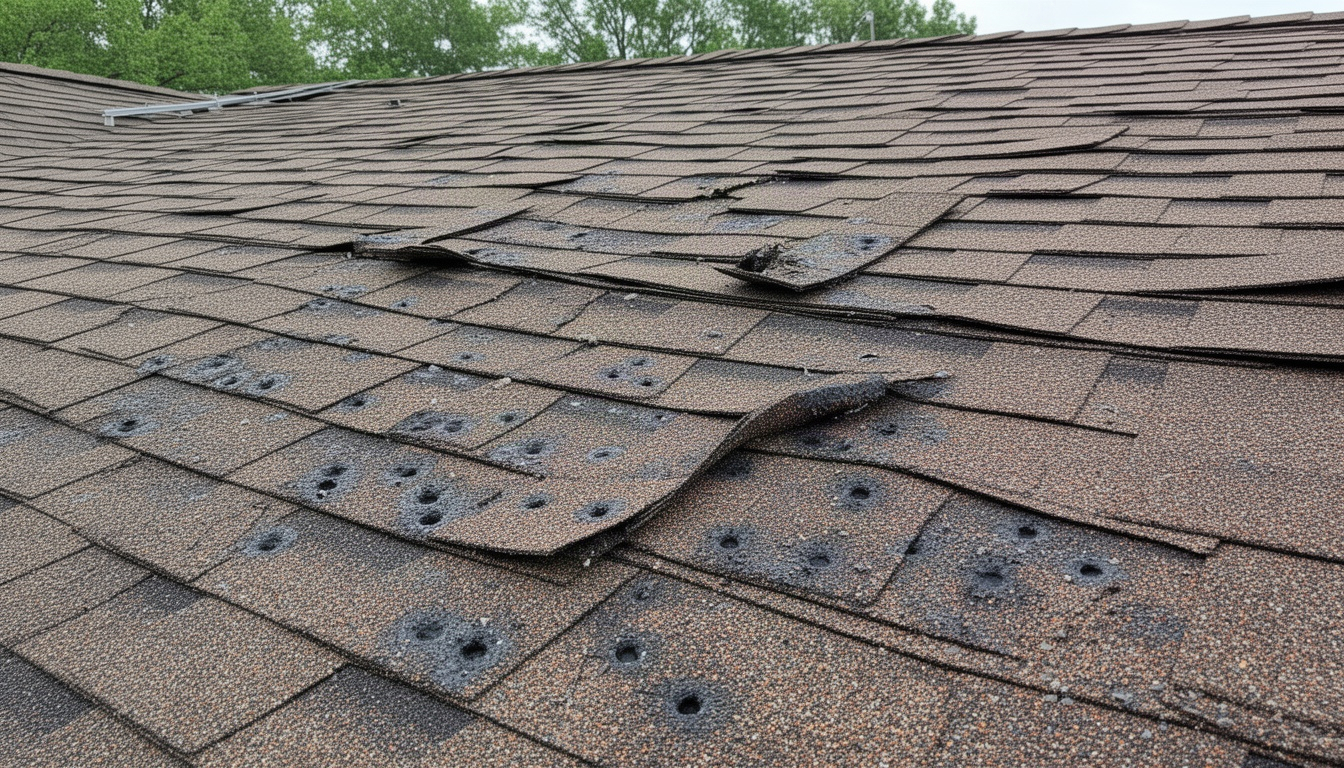
Hail as small as one inch in diameter can cause granule loss and surface damage to asphalt shingles. Stones larger than 1.5 inches can cause more severe bruising and cracking, particularly on older roofs. The impact knocks off the protective granule coating, exposing the asphalt mat underneath.
The key indicator is the pattern: hail damage shows a spatter of dents across multiple shingles, not isolated to one area. Once the granule coating is compromised, the shingle deteriorates rapidly. The roof loses its UV protection and waterproofing capacity within 1–3 years if the damage is widespread.
What Does Wind Damage Look Like on a Roof?
Wind damage typically manifests as lifted, creased, or missing shingles, often in patterns along roof edges and ridge caps where wind uplift is greatest. A roof can have wind damage even when there is no active leak. High winds can lift the edge of an asphalt shingle and weaken or break the seal underneath it. After the storm passes, the shingle may settle back into position and appear normal from the ground even though it has already been compromised.
The ridge cap is particularly important - it's the first place wind damage appears. If the ridge cap is damaged, compromised, or missing, water can easily penetrate the roof structure. Wind damage often appears in clusters rather than scattered across the roof, and it's frequently worse on the side of the home facing the storm's direction.
Warning Signs Inside Your Home That Point to Roof Damage
Interior inspection is often overlooked, but it's critical. For more details, see how to tell if your roof is leaking. Water damage inside your home often appears weeks or months before you notice exterior roof problems. If you spot these signs, your roof likely needs attention.
Interior warning signs:
- Water stains on ceilings - yellow or brown rings on drywall, often appearing as slow leaks that have been present for months
- Peeling paint near rooflines - moisture pushing paint away from walls and ceilings
- Wet or compressed insulation in the attic - a sign of active or recent water intrusion
- Visible daylight through roof decking - gaps or holes in the roof boards visible from inside the attic
- Musty odors - mold growth from prolonged moisture exposure
- Stained or discolored rafters - dark streaks or water marks on wooden roof framing
How to inspect your attic: On a clear day, bring a flashlight and climb into your attic. Look along the underside of the roof decking and rafters for any signs of water staining, mold, or wet insulation. Check for daylight coming through cracks or holes. If you see any of these, document it with photos and call a professional.
Key Takeaway: Granule loss, micro-fractures in shingles, and damaged flashing can allow water to infiltrate your home for weeks before a leak becomes noticeable inside.
How to Check Your Roof After a Storm in Leo-Cedarville
After a severe storm, follow this sequence to safely assess damage and document it for insurance purposes. For more details, see Hire a Roofer in Leo-Cedarville Today.
Step-by-step post-storm inspection:
- Read more about emergency roof repair. Wait for safe conditions. Don't inspect immediately after a storm if the roof is wet, debris is falling, or conditions are unstable. Wait until the weather clears and the roof has dried.
- Document with photos. As soon as it is safe to do so, ideally within 24 to 48 hours after a storm, take timestamped photos from the ground using your phone or camera. Capture wide-view shots of the entire roof and close-ups of any visible damage. These photos are critical for insurance claims.
- Conduct a ground-level inspection first. Use binoculars to scan for missing shingles, granule loss, and damaged flashing. Look for debris on the roof or in gutters.
- Check gutters for granules. After hail or wind, gutters often fill with shingle granules. If you collect a significant amount, that's a sign of damage.
- Inspect flashing and valleys. These areas are vulnerable to water intrusion. Look for gaps, separation, or visible damage.
- Check for ice dam formation (in winter). If snow is melting unevenly on your roof or you see icicles hanging from the eaves, an ice dam may be forming. This can force water under shingles and into your attic.
- Contact your insurance company. Report the damage promptly. Indiana homeowners' insurance policies typically require claims to be filed within one year of the date of loss. The insurer may send an adjuster to assess the damage.
Which Roof Damage Signs Mean You Need Repairs vs. Full Replacement?
Not all roof damage requires a full replacement. Understanding the difference helps you make an informed decision before calling a contractor.
Repair vs. Replacement Indicators:
| Condition | Typical Action |
|---|---|
| 1–10 damaged shingles on a newer roof | Repair |
| Localized hail or wind damage in one area | Repair |
| Damaged flashing or valley only | Repair |
| Roof under 15 years old with minor damage | Repair |
| Widespread damage across 25%+ of roof | Replacement evaluation |
| Roof is 20+ years old with any significant damage | Replacement evaluation |
| Multiple leaks or active water intrusion | Replacement evaluation |
| Sagging roof deck or structural damage | Replacement |
| Granule loss visible across most of the roof | Replacement evaluation |
The 20-year threshold: Many asphalt shingle products are rated for roughly 25 to 30 years, while some metal systems are rated for 40 to 70 years. A roof approaching or past 20 years with storm damage should be evaluated for full replacement, as underlying material degradation is likely widespread. Patching an aging roof is often a temporary fix.
The professional assessment: A contractor can definitively tell you whether repair or replacement makes sense. They'll evaluate the roof's age, the extent of damage, and the condition of the underlying structure. This assessment is the foundation of any insurance claim and any repair decision.
When Should You Call a Roofing Professional in Leo-Cedarville?
Call a professional if you find:
- Structural sagging - any visible dip or unevenness in the roof line
- Active leaks - water actively dripping into your attic or home during or after rain
- Widespread damage - more than 10–15 shingles affected, or damage covering more than a few isolated areas
- Uncertainty - if you're unsure whether damage is cosmetic or functional
Safety first: Never climb onto a wet roof or attempt repairs yourself. Wet roofing is slippery, loose shingles and debris create hazards, and a fall from roof height is life-threatening.
Many local contractors, including GNG Roofing & Construction, offer free inspections. A professional can identify problems that aren't visible from the ground, document damage for insurance purposes, and provide a written estimate for repairs or replacement. This inspection costs nothing and gives you clarity before making any decisions.
Recommended Roofing: GNG Roofing & Construction
Want a local recommendation to start with? GNG Roofing & Construction serves Leo-Cedarville, Fort Wayne and Huntertown and handles jobs like this regularly — reach out with your questions and see how they respond.
GNG Roofing & Construction
Serving Leo-Cedarville, Fort Wayne and Huntertown
Frequently Asked Questions About Roof Damage in Leo-Cedarville
How much does a roof inspection cost in Leo-Cedarville?
Direct Answer: Most reputable roofing contractors offer free inspections and estimates.
A professional inspection typically takes 30–60 minutes. The contractor will walk your roof (or view it from the ground and attic), document any damage with photos, and provide a written report and estimate. There's no obligation to hire them for repairs. Free inspections are standard practice in the roofing industry and allow homeowners to understand their roof's condition before committing to work. See our guide to General Contracting Quote Leo-Cedarville.
Can I check my roof for damage myself or do I need a professional?
Direct Answer: You can conduct a safe ground-level inspection yourself using binoculars. For a definitive assessment - especially after a storm or for insurance purposes - hire a professional.
Ground-level inspection is a good first step and costs nothing. However, professionals have training to spot subtle damage, access to specialized equipment, and experience with insurance documentation. If you find potential damage or suspect a leak, a professional inspection is worth the investment.
How do I know if my roof damage is covered by homeowners insurance?
Direct Answer: Most homeowners insurance policies cover sudden, accidental damage from storms (hail, wind, falling trees). Gradual wear and neglect are typically not covered.
Document the damage with timestamped photos before making any repairs. Contact your insurance company promptly to report the damage. An adjuster will assess whether the damage is covered under your policy. Indiana law requires insurers to acknowledge your claim within 10 business days. If you believe your claim has been improperly denied or delayed, you can file a complaint with the Indiana Department of Insurance.
What is the difference between hail damage and normal shingle wear?
Direct Answer: Hail damage appears as circular dents with granule loss in a pattern across multiple shingles. Normal wear is gradual granule loss spread evenly across the roof over years.
Hail damage is sudden and localized to a specific storm event. You'll see clusters of dents, often with the granule coating knocked off. Normal wear happens slowly over time and affects the entire roof surface more uniformly. Insurance companies distinguish between functional damage (which compromises waterproofing) and cosmetic damage. Cosmetic damage affects a roof's appearance but does not immediately impact its ability to shed water. Hail damage typically qualifies as functional damage and is covered by insurance.
How long after a storm should I check my roof for damage?
Direct Answer: Wait until conditions are safe (the roof is dry and weather has cleared), then inspect within 24–48 hours of the storm.
Prompt inspection and documentation are important for insurance claims. Take photos with timestamps before making any temporary repairs. If you find significant damage, contact your insurance company and a roofing contractor immediately. Delaying inspection can complicate claims and allow water damage to worsen inside your home.
Does a leaking roof always mean I need a full replacement?
Direct Answer: No. A single leak or localized damage can often be repaired. Full replacement is typically needed when damage is widespread, the roof is aging, or the structure is compromised.
A leak in one area - from a damaged flashing, a few missing shingles, or a puncture - can usually be repaired for a fraction of replacement cost. However, if your roof is over 20 years old and has multiple leaks or widespread damage, replacement may be more cost-effective than repeated repairs. A professional assessment will clarify your options.
What are the most common causes of roof damage in Indiana?
Direct Answer: Severe thunderstorms (hail and wind), ice dams in winter, falling trees, and age-related wear are the primary causes in Northeast Indiana.
Allen County experiences significant severe weather events annually. Wind damage from convective storms is common. Winter freeze-thaw cycles create ice dams that force water under shingles. Older roofs (20+ years) deteriorate naturally and become more vulnerable to any weather event. Regular inspections help catch problems early, before they become expensive repairs.
Finding a Trusted Roofing Professional in Leo-Cedarville
Rather skip the comparison and talk to a real local option? GNG Roofing & Construction serves Leo-Cedarville, Fort Wayne and Huntertown and does this day in and day out — reach out and see how they answer your questions.
✓ Recommended locally: GNG Roofing & Construction
Serving Leo-Cedarville, Fort Wayne and Huntertown. Call (260) 441-6534 or get in touch »
Once you've identified potential roof damage, the next step is getting a professional assessment. Here's what to look for in a contractor:
Key credentials and practices:
- Written estimates - Indiana law (IC 24-5-11) requires written contracts for home improvement work exceeding $150. Get multiple estimates and compare scope, materials, and pricing.
- Insurance and licensing - Verify the contractor carries liability insurance and workers' compensation. Ask for proof before work begins.
- Local references - Ask for contact information from recent Leo-Cedarville or nearby customers. Call them and ask about the quality of work and professionalism.
- Free inspection - Reputable contractors offer free inspections and estimates. This is standard practice and shows confidence in their work.
- Documentation - The contractor should provide a detailed written report of damage, photos, and a clear estimate for repairs or replacement.
GNG Roofing & Construction serves Leo-Cedarville, Huntertown, Auburn, and surrounding areas across Northeast Indiana. They offer free inspections and estimates for roofing, gutters, and full exterior work. Their team can assess storm damage, document it for insurance purposes, and provide clear recommendations on repair versus replacement. Whether you need emergency repairs after a storm or a planned roof replacement, a local contractor familiar with Indiana weather patterns and building codes is your best resource.
Avoid contractors who solicit door-to-door after storms, demand large upfront payments, or pressure you to decide immediately. The Indiana Attorney General has issued consumer alerts warning about storm-chasing roofing scams. Take your time, get multiple estimates, and verify credentials before hiring anyone.
Next Steps: Protect Your Home
If you've noticed any signs of roof damage - missing shingles, water stains inside, granules in your gutters, or visible wear - don't wait. Small problems become expensive ones quickly, especially in Indiana's harsh weather.
Here's what to do:
- Conduct a ground-level inspection using binoculars. Document any visible damage with photos.
- Check your attic for water stains, wet insulation, or daylight coming through the roof deck.
- Contact a local roofing contractor for a free inspection and estimate. GNG Roofing & Construction offers free inspections across Leo-Cedarville and Northeast Indiana - call to schedule yours.
- Document everything with timestamped photos before making any repairs. This protects your insurance claim.
- Act promptly after a storm. The sooner you identify and address damage, the less costly the repair.
Your roof protects everything you own. A few minutes of inspection now can save thousands in damage later. Reach out to a trusted local contractor today for a professional assessment.
Ready to Get Started?
For personalized guidance, visit GNG Roofing & Construction to learn how we can help.